Alexander became king when only 20 and in an amazing eleven-year journey of conquest rode 10,00 miles, fought 70 battles without losing a single one and conquered all the way from Egypt to India – half the known world of those times. All this in a life spanning a mere 32 years! Obviously an achievement of such epic proportions could not have happened without the display of some amazing leadership qualities. What leadership qualities of Alexander made historians label him 'Great'? Here are 7 incidents from the short life of Alexander, that are illustrative of his leadership style and which we could take lessons from.
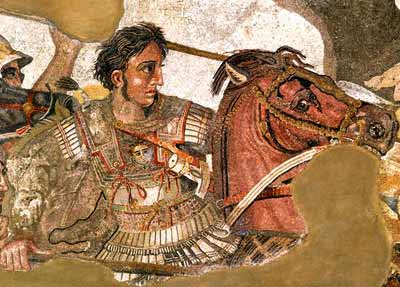 |
| Alexander the Great Source Encyclopedia Britannica |
Leadership Lesson #1: Have An action orientation
Action was what Alexander wanted from life. He hated a life of comfortable sloth. When he heard of the conquests of his father, King Philip of Macedonia, Alexander was not happy about the additional wealth and power that he would inherit, but instead was sad that there would be less left for him to conquer. Alexander often lamented to his friends that the way things were going nothing would be left for him to do once he became king!
Leadership Lesson # 2: Care for your people
Between 30,000 and 43,000 infantry and between 3,000 and 4,000 horsemen followed Alexander into Asia Minor [334 B.C.]. He had only 70 talents (Greek currency) for their pay, and no more than thirty days' provisions. Alexander was 200 talents in debt, having spent everything he had in making sure that his best men were able to provide for their families. When one of his generals asked what he had kept for himself, Alexander answered: "My hope." On hearing this, the general refused the pension that Alexander offered him, saying: "Your soldiers will be your partners in that."
After covering four hundred miles in eleven days in the battle against King Darius, Alexander and his soldiers were nearly dead from thirst. Some Macedonian scouts had brought back a few bags of water from a distant river, and they offered Alexander a helmet-full. Although his mouth was so dry that he nearly was choking, he gave back the helmet with his thanks and explained: "There is not enough for everyone, and if I drink, the others will faint." When his men saw this, they spurred their horses forward and shouted for him to lead them. With such a king, they said, they would defy any hardships.
In the city of Gordium, Alexander accepted the challenge of the Gordian knot. A very intricate knot tied together the yoke of an ancient chariot, and there was a legend that whoever could undo the knot would become the master of the world. Alexander pulled out his sword and chopped through the Gordian knot, instead of involving himself in its mysterious entanglements.
One day, Alexander fell behind the rest of his army because his old teacher, Lysimachus could not keep up. Night found Alexander in a very dangerous position: far behind his army and without any fire to combat the cold. He noticed some enemy campfires, so he ran over to one, killed two soldiers with his knife, then carried back a burning stick to his men. This was typical of Alexander -- he was always encouraging his men by a personal example of readiness to work and face danger.
One night at Gaugamela, the armies of Alexander and Darius, King of Persia, came in sight of each other. The noise and campfires of the vast barbarian camp were so frightening that some of Alexander's generals advised a night attack because it would be too dangerous to take on such a huge force in daylight. But Alexander replied: "I will not steal victory."
Another time, one of the common soldiers was driving a mule that carried some of Alexander's treasure. The mule was too exhausted to go on, so the soldier put the load on his own shoulders. Alexander saw the man staggering along, and he asked what was the matter. The soldier told him that the mule was too tired to carry the load, and that he was about at the end of his endurance too. "Don't give up now," said Alexander, "but carry what you have there to the end of the journey, then take it to your own tent, to keep for yourself."
These incidents offer us an understanding of why Alexander truly deserved the title of 'The Great'. But was his epic achievement a result only of his remarkable leadership skills and courage? In the words of a fellow Greek – Euripedes, 'Courage is nothing if the gods withhold their aid'. Can one say the same of leadership skills too?
Was Alexander truly a Leadership ka Sikander or was he a Muqqadar ka Sikander - the most favoured child of God?